Before the room, there is the material.
Before the garment, there is the material.
Every finished expression begins somewhere earlier — with a fibre, a structure, a weight, a hand, a surface, a decision.
For Quinta del Hilo Group, that sequence matters.
Our first commercial expression, Lusso Fabrics, begins with linen because the House itself begins with a simple principle:
Material first.
Not because technology, design or service matter less. They matter because they can help us understand, select and work with the material more intelligently.
But the material comes first.
Linen is not a new material searching for relevance.
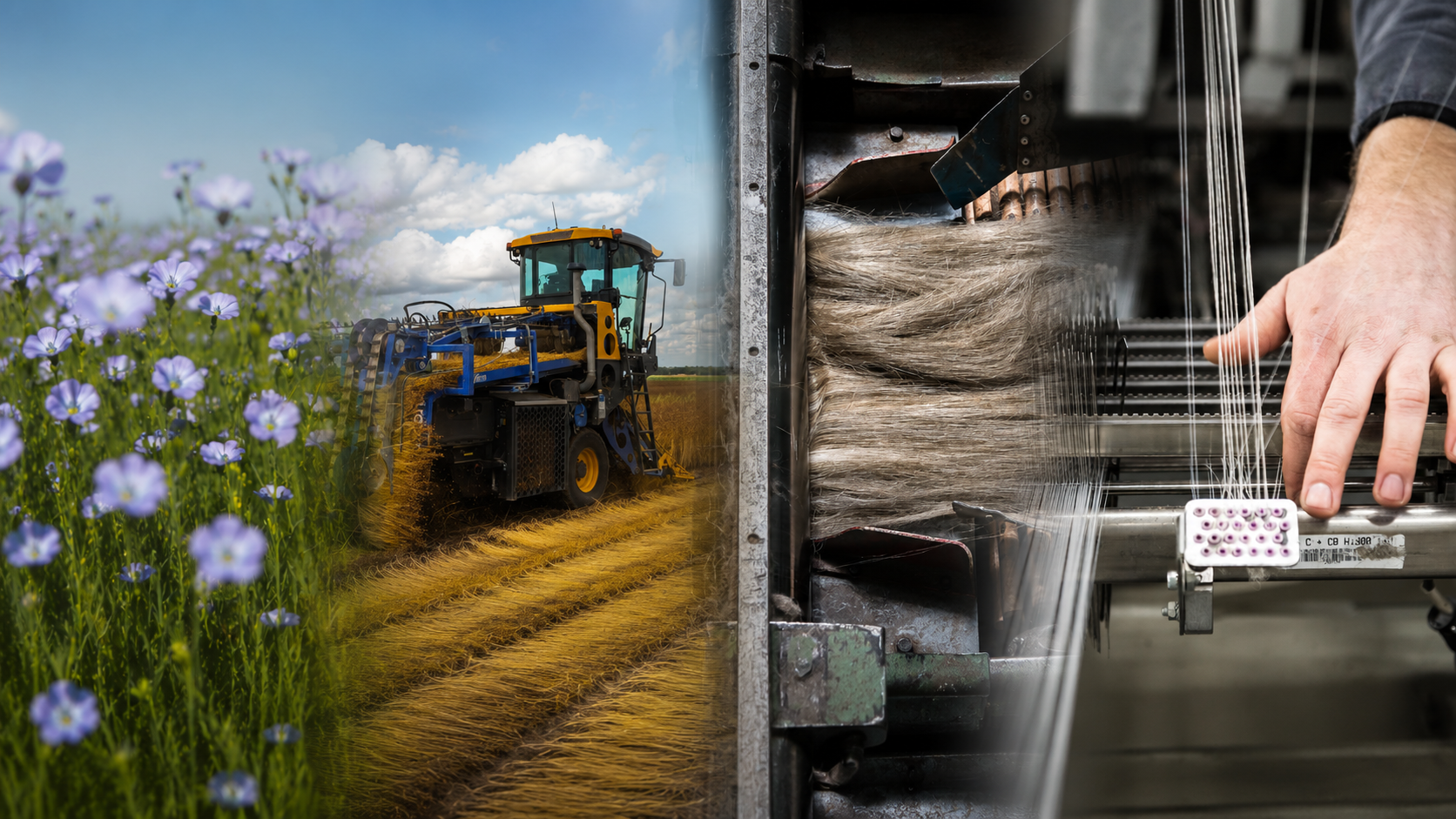
It is one of humanity’s oldest textile materials, made from the fibres of the flax plant and used across centuries for clothing, domestic textiles and other forms of material culture. Its history is unusually close to agriculture: before there is yarn or cloth, there is a plant growing in a field.
That connection remains visible today.
Flax is cultivated extensively across a Western European coastal region stretching through France, Belgium and the Netherlands. The combination of climate, soil and generations of agricultural and textile knowledge has made this region particularly important to contemporary flax production. Today, roughly three-quarters of the world’s long flax fibre production comes from these three countries.
For us, that matters not as a claim of prestige, but as a reminder:
materials carry geography, process and knowledge within them.
The distance between a flax field and a finished linen cloth contains many decisions.
The plant is grown and harvested, then undergoes retting, a natural process in which moisture, dew, sunlight and microorganisms help separate the textile fibres from the woody parts of the stem. The material is then prepared through stages including scutching and hackling, which extract, clean and align the fibres before they can be spun into yarn. From there come spinning, weaving or knitting, finishing — and eventually the cloth that reaches the designer.
Each transformation changes what comes next.
Fibre quality affects yarn.
Yarn affects construction.
Construction affects weight, texture and movement.
Finishing changes hand and character.
And those qualities influence what a designer can ultimately ask the material to become.
This is why we believe understanding linen cannot end with composition or color.
A professional selection also asks:
How does it fall?
How does it catch light?
How does it feel in the hand?
How is it constructed?
What does its weight allow?
What happens when it becomes a curtain, a jacket, a headboard or a dress?
The specification matters.
The behavior matters too.
Lusso Fabrics was not conceived as a catalog trying to contain every textile category.
It was built around specialization in linen — bringing together considered European materials, material knowledge and a professional Trade experience for Interior and Fashion professionals.
That distinction is important.
Our objective is not simply to give a designer more options.
It is to create a better path through them.
That means understanding a material before recommending it. Creating context around weight, construction, texture, finish and application. Making it easier to compare. And, eventually, using digital tools where they genuinely improve clarity.
The Digital Showroom, Lusso Advisor and the broader Trade experience will become part of that story.
But they are not where the story begins.
They exist in service of something more fundamental:
the material itself.
This is consistent with the philosophy behind Quinta del Hilo Group: technology should amplify knowledge, service and the material experience — never replace them.
A beautiful textile can attract attention.
Understanding why it belongs in a project creates something more useful: confidence.
For an Interior professional, that understanding may involve light, texture, width, movement, durability or the relationship between different materials in a space.
For a Fashion professional, the questions may turn toward weight, drape, finish, structure, movement and the way a cloth responds when it becomes a garment.
The contexts are different.
The principle is the same.
Knowledge around the material makes the decision clearer.
This is the role Lusso intends to play: not to replace the designer’s judgment, but to support it — through selection, context and a deeper understanding of the material being considered.
Beginning with the material creates another question.
If the objective is not to accumulate as many fabrics as possible, what deserves to enter the selection?
What makes one linen relevant and another unnecessary?
What should a considered collection contain?
And perhaps more importantly:
What should it leave out?
That is the next chapter.
Selected, Not Accumulated.
Image credits: © Alliance for European Flax-Linen & Hemp
Selected source information: Alliance for European Flax-Linen & Hemp